
A notice of non-renewal is a written notice that a lease will end on its end date and won't be renewed. Either the landlord or the tenant can send it. How far ahead it must go out, and how it must be delivered, depend on the lease and on the landlord-tenant law of the state, and sometimes the city, where the home is.
What is a notice of non-renewal?
A fixed-term lease has an end date. What happens on that date depends on the lease: it may simply end, or the lease may say it renews or continues month to month. A notice of non-renewal tells the other side, in writing, that you don't want the lease to continue past its end date.
Unlike an eviction notice, it doesn't cut the tenancy short. The lease runs to its end date and stops there.
Who sends it
Both sides can. A non-renewal letter is "sent by a landlord to a tenant, or by a tenant to a landlord" (Stessa).
A tenant sends one when they plan to move out at the end of the term, especially if the lease would otherwise renew automatically or roll into month-to-month.
A landlord sends one when they won't offer a new lease, for example because they are selling the property or moving in. In most states a landlord doesn't need to give a reason to let a fixed-term lease end, but the decision can't be discriminatory or made to retaliate against the tenant (FindLaw).
Some places go further and limit when a landlord can refuse to renew at all:
- New York. Under the Good Cause Eviction law, "most landlords cannot evict their tenants or refuse to renew their leases just because their lease has expired". It applies in New York City, Albany, Rochester and a number of other cities (New York Attorney General).
- California. Once a tenant has lived in a home for 12 months, the owner "shall not terminate a tenancy without just cause", with exceptions set out in the law (Cal. Civ. Code §1946.2).
Other states and cities have their own rules. If you are a landlord in a city with rent control or tenant protections, check them before you send anything.
What it usually includes
There is no single required form, but these details show up in most notices (Stessa):
- the date of the notice
- the names of the landlord and the tenants, as they appear on the lease
- the address of the rental home
- the date the lease ends
- a clear statement that the lease will not be renewed
- what happens next, such as a move-out inspection and returning keys
- the security deposit and how it will be returned, with a forwarding address for the tenant
- a reason, if you choose to give one or if local law requires it
The person giving notice signs it. Keep it short and factual.
How much notice you need
Start with the lease. Many leases say how far ahead either side must give notice before the end date, and what happens if no one does.
Then check the law. The required notice period "varies based on the terms and conditions of the lease and the state landlord-tenant law where the property is located" (Stessa). Some cities add their own rules on top of the state's.
If you're unsure, send the notice early rather than late, and read the renewal clause in your lease to see what happens if no one gives notice in time.
How to deliver it
The lease often lists how notices must be delivered: by hand, by mail, to a specific address. City and state landlord-tenant laws also "dictate how a legal notice … must be delivered" (Stessa).
Whether you can deliver it by email or as an electronic document depends on the lease and the local law. Check your lease and state law before relying on it: some notices must be delivered on paper. Federal e-signature law, for example, does not cover notices of eviction from a primary residence (15 U.S.C. §7003). A non-renewal notice is a different document, but it shows that housing notices can be held to stricter rules.
Whatever method you use, keep proof of when the notice was delivered. Certified mail with a return receipt, or a courier with a delivery record, gives you a date that is hard to argue with.
Sign and send it from your iPhone
If you have written the notice and need to sign it, you can do that on your phone. Save it as a PDF, open it in eSign Me and place your handwritten signature: you sign a sheet of paper once, and the app lifts the ink off the page. Then print it for delivery, attach it to an email, or both, depending on what your lease and local law require.
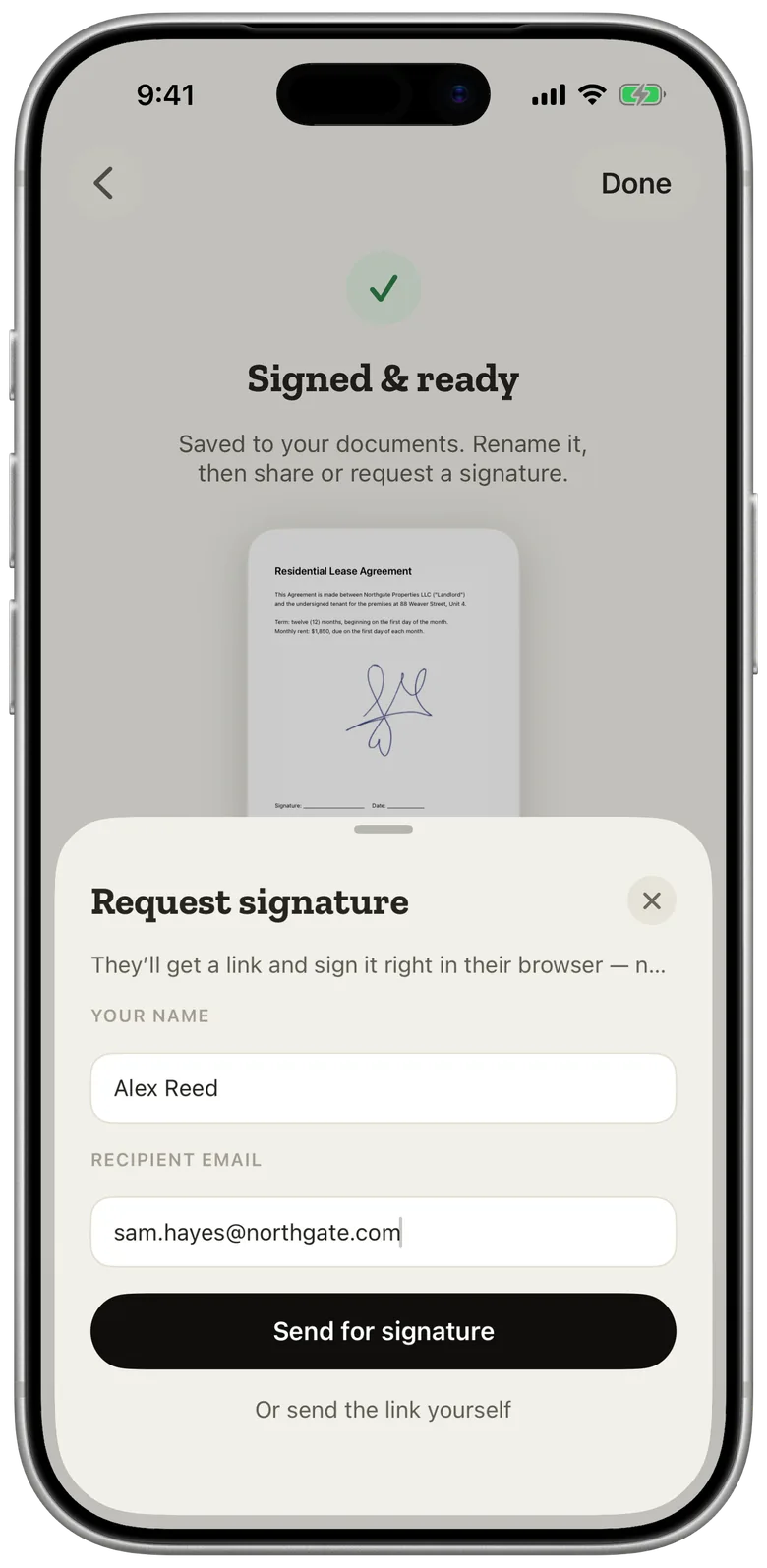
If you want the other side to sign that they received it, send them a signing link. They open it in a browser on any phone or computer and sign, with no app and no account, and the signed copy comes back to you. That gives you a signed acknowledgment, but it doesn't replace delivery in the form your lease or local law requires.
The same app handles the next step, too. If a new tenant is moving in, the landlord can send the new lease for signing the same way; how to sign a lease online walks through it. Whether e-signatures work for a particular document is covered in how US law treats electronic signatures.
General information, not legal advice.
Questions
How much notice do I need to give?
Start with your lease: many leases say how far ahead either side must give notice. State and sometimes city law set their own rules as well. Check both before you pick a date.
Can I send a notice of non-renewal by email?
Only if your lease and the law where the home is allow it. Many leases list the ways notice must be delivered, and some notices must be delivered on paper. If in doubt, deliver it the way the lease says and keep proof, such as a certified mail receipt.
Does the other side have to sign it?
The person giving notice signs it. You can also ask the other side to sign that they received it, but that doesn't replace delivery the way your lease or local law requires.